You own a small business in 2026. Maybe you run a dental practice in Istanbul, a roofing company in Oklahoma, or a bakery in Berlin. You know you need a website. So you open Google and type "how to make a website for my business."
And immediately, you hit a wall of options.
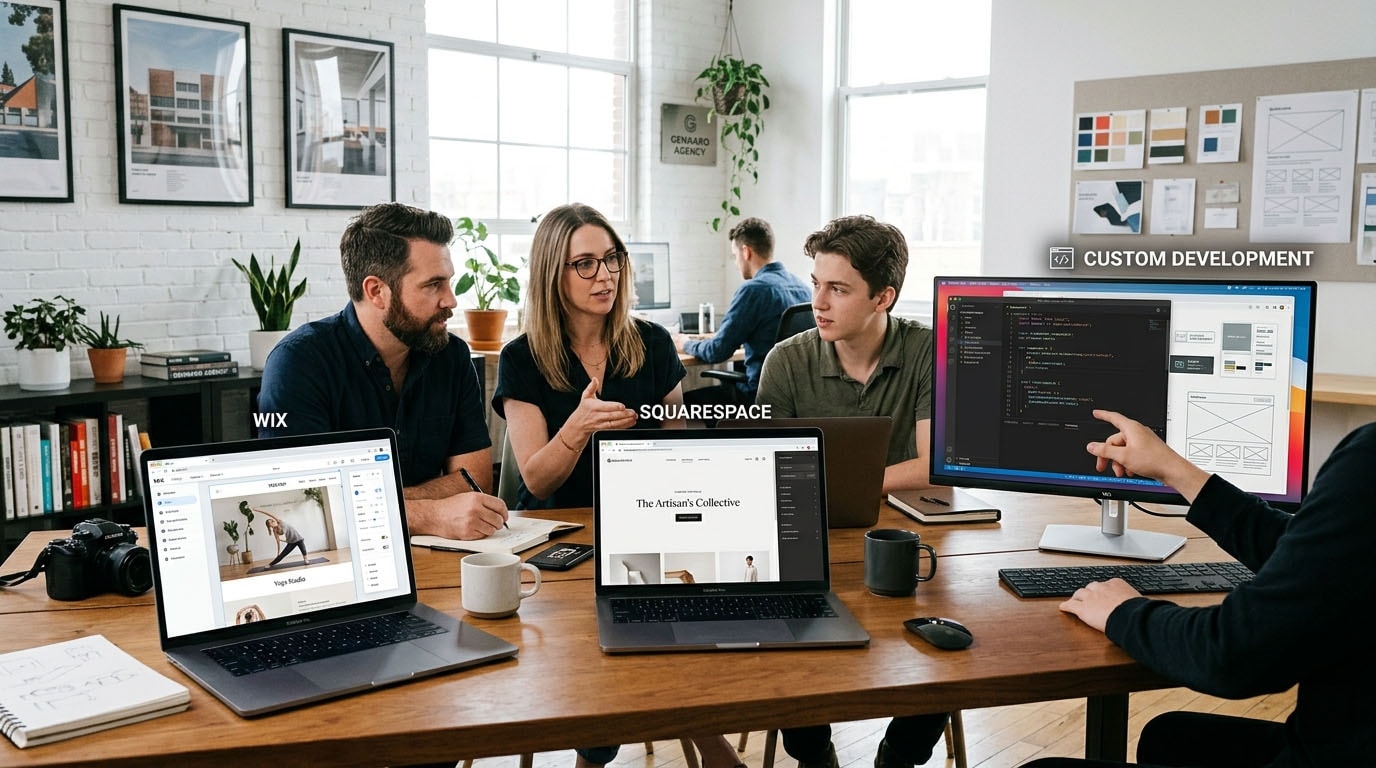
Wix promises you can build a site in minutes. Squarespace has beautiful templates. WordPress powers 43% of the web. And then there is the "custom development" option that sounds expensive and complicated.
Which one should you actually pick?
The answer is not as simple as the DIY platforms want you to believe. In 2026, your choice determines whether Google shows you to local customers, whether ChatGPT recommends your business, and whether visitors actually call you instead of bouncing.
Let's break down exactly what each option delivers for a real small business.
The Hard Truth About Website Builders in 2026
Website builders like Wix, Squarespace, GoDaddy, and IONOS have one big advantage. They are easy to start. You pick a template, drag elements around, and have something live by the end of the day.
That feels great. Until you hit their limits.
Here is what most small business owners discover three to six months in.
1. You Cannot Fix Basic SEO Issues
DIY platforms control your URL structure, your heading hierarchy, and your page speed. If Google decides your site is too slow, you cannot just fix it. You are stuck waiting for the platform's engineering team to optimize their infrastructure.
According to a 2025 study by HTTP Archive, Wix and Squarespace sites consistently score lower on Core Web Vitals compared to custom-built sites. The average Largest Contentful Paint (LCP) for Wix sites is 2.8 seconds. Google recommends under 2.5 seconds. Custom-built sites on modern frameworks average 1.2 seconds.
That one and a half second difference directly impacts your local search ranking.
2. You Do Not Actually Own Your Content
Try migrating from Wix to another platform. The process involves manually copying each page, rewriting image URLs, and rebuilding your design from scratch. Your SEO rankings disappear during the transition because every URL changes.
With a custom-built website, your content, your URLs, your design, and your SEO equity all belong to you. You can move hosts, change developers, or redesign without losing years of ranking history.
3. Customization Hits a Hard Ceiling
Professional websites in 2026 are not static brochures. They integrate with booking systems, CRM tools, payment processors, and marketing platforms.
A dental practice might need online appointment booking with automated reminders. A roofing company might need a project portfolio with before-and-after galleries. A restaurant might need an online ordering system with real-time inventory.
DIY platforms offer limited integrations through app marketplaces. But these apps add monthly fees, slow down your site, and often break when the platform updates. A custom solution integrates exactly what you need, nothing more, nothing less.
4. Mobile Optimization Is Not Optional
Google has been mobile-first for years. But in 2026, over 62% of all local searches happen on mobile devices. If your website is not optimized for mobile, you are invisible to the majority of your potential customers.
DIY platforms do offer mobile responsive templates. But the responsiveness is often superficial. Text gets crammed. Buttons overlap. Navigation menus become frustrating. A custom-built site is designed mobile-first, not mobile-added-later.
The Three-Year Cost Analysis Nobody Talks About
Let us do the real math.
DIY Platform (Wix/Squarespace/GoDaddy)
You sign up for $20 to $35 per month. Over three years, that is $720 to $1,260 in subscription fees.
But the cost does not stop there. You also pay for:
Domain registration: $15/year = $45
Premium templates: $0 to $200 one-time
Third-party apps for bookings, forms, analytics: $10 to $50/month extra
SSL certificate (sometimes included, sometimes not): $0 to $100/year
Real three-year total: $1,200 to $2,500.
And at the end of three years, you own nothing. Your content is locked in their ecosystem and your SEO rankings vanish if you try to leave.
Custom Development (Professional Agency)
You pay $3,000 to $8,000 upfront for a professionally built website with a modern tech stack.
Then ongoing costs:
Hosting: $15 to $30/month = $540 to $1,080 over three years
Domain: $15/year = $45
Maintenance and updates: $50 to $150/month if you have a retainer = $1,800 to $5,400
SSL certificate: Included with good hosting
Real three-year total: $5,400 to $14,500.
That sounds like a lot more. But here is what you actually get.
The Revenue Side of the Equation
A professionally built website that loads in under one second and ranks well for local keywords will bring in customers. Consistently.
Let us use realistic numbers.
A local roofing company averages $8,000 per project
A dentist averages $400 per new patient visit
A boutique hotel averages $250 per night booking
If your custom website brings in just two extra clients or bookings per month that you would have lost with a slow DIY site, it pays for itself in under a year.
The question is not "can I afford a custom website?" The question is "can I afford the customers I am losing with a DIY site?"
Why DIY Platforms Are Optimized for One Thing
Think about what Wix and Squarespace actually sell. They sell subscriptions. Every month you stay on their platform, they make money.
So their incentives are aligned with keeping you on the platform. Not with making your business more money.
They want you to use their app marketplace (more revenue).
They want you to use their email marketing (more revenue).
They want you to upgrade to a higher tier (more revenue).
Your goal is to get found, get called, and get paid. These two sets of incentives are not the same.
A custom developer is paid to build something that works. Their reputation depends on whether your website actually brings in business. The incentives are aligned.
The GEO Factor: Why 2026 Is Different
Generative Engine Optimization, or GEO, is the biggest change in local search since Google's algorithm itself.
Here is what is happening. When a customer asks ChatGPT or Perplexity "find me the best electrician in Columbus," the AI does not show a list of links. It generates a detailed answer by synthesizing information from multiple sources.
If your website is not structured for this, you do not appear. Even if you rank number one on Google, the AI-generated answer can satisfy the customer's question before they ever see your link.
Over 60% of users now engage with AI-generated answers before clicking a traditional search result. That number is growing every quarter.
Traditional Search
1. User types keywords
2. Clicks a link
3. Visits the website
AI Search / GEO
1. User asks a question
2. AI reads structured data
3. AI recommends the business
How GEO Affects Your Platform Choice
DIY platforms are not designed for GEO. They do not give you control over structured data. They do not let you add FAQ schema easily. They do not optimize your content for citation by AI engines.
A custom-built website gives your developer full control over:
Schema markup. Properly structured data that tells AI engines exactly what your business does, where you are located, and what services you offer.
Citeable statistics. Well-formatted data points that AI engines love to pull into their generated answers.
Clear heading structure. H1, H2, H3 hierarchy that helps AI understand your content's organization.
Question-based content. Pages structured around the exact questions customers ask, which AI engines use to build their answers.
In 2025, BrightLocal found that only 12% of small business websites had any form of structured data implemented. That means 88% of your competitors are invisible to AI search engines. A custom-built site fixes this from day one.
Where DIY Platforms Actually Make Sense
To be completely fair, there are situations where a DIY builder is the right choice.
You are testing a business idea and need something live in one afternoon to validate demand.
You have zero budget and no revenue yet. A $20/month Wix site is better than no site at all.
You are building a simple landing page for a specific campaign that will run for a few months.
Your business is purely local with no competition and all customers come through word of mouth.
But if you are an established business with real competitors and real growth goals, these situations are rare.
What to Look for in a Professional Developer
If you decide to go the custom route, not every developer delivers the same results. Here is what separates a good investment from a waste of money.
They Build With Modern Tech
Ask your developer what framework they use. If the answer is "Next.js," "Astro," or "Remix," you are in good hands. These frameworks deliver sub-second load times out of the box.
If the answer is "WordPress with a page builder" or "raw PHP," ask some follow-up questions about performance. WordPress can work well when properly optimized, but most small business WordPress sites suffer from bloat, slow plugins, and security vulnerabilities. A 2025 report by Patchstack found that over 50% of WordPress vulnerabilities come from third-party plugins.
If the answer is "jQuery" or "Dreamweaver," run the other way.
They Understand Local SEO and GEO
A web developer in 2026 must understand more than HTML and CSS. They need to understand:
Google Business Profile optimization
Local schema markup (LocalBusiness, FAQ, Review schemas)
Core Web Vitals and how to optimize for them
Content structure that AI engines can parse
Location-specific landing pages
Ask your developer about their SEO workflow. If they have a standard SEO checklist they apply to every project, that is a good sign.
They Offer Ongoing Support
Websites are not "build once and forget" projects. Security patches, content updates, plugin updates, and performance monitoring all require ongoing attention.
A good developer offers a maintenance retainer or at least an hourly support arrangement. Expect to pay $50 to $150 per month for basic maintenance, depending on the complexity of your site.
They Have Local Business Experience
A developer who only builds SaaS apps or e-commerce stores might not understand the specific needs of a local service business. Look for a portfolio that includes real projects for businesses similar to yours.
Dental practices, law firms, plumbing companies, HVAC contractors, restaurants, and boutique hotels all have different website requirements. Experience in your specific industry is a huge advantage.
A Practical Decision Framework
Here is a simple way to decide which path is right for you.
Choose DIY If... | Choose Custom Development If... |
|---|---|
Your monthly marketing budget is under $200 total | You have an established business with monthly revenue over $10,000 |
You need a site up in under one week | Your competitors have professional websites |
Your business has no direct competitors nearby | You want to rank on Google AND AI search results |
You are comfortable learning basic SEO yourself | You value long-term ownership and control |
You do not plan to grow or add features over time | You intend to grow your business and add features over time |
Customer acquisition cost is high (each new customer is worth significant revenue) |
The Bottom Line
In 2026, your website is not a brochure. It is your most important sales tool. It is how customers find you on Google, how ChatGPT recommends you, and how visitors decide whether to call you or your competitor.
A $30/month Wix site can get you online. But if it loads slowly, ranks poorly, and disappears from AI search results, how much is it actually costing you in lost customers?
Let us put it this way. A friend comes to you and says "I can save you $50 a month on your business phone line." But the catch is, the cheaper phone line drops every third call and your customers cannot reach you.
Would you take that deal? Of course not. The lost revenue from missed calls is far more expensive than the $50 you save.
The same logic applies to your website. The cheapest option is rarely the best investment for your business.
Ready to Build a Website That Actually Works?
At Gennaro Agency, we build fast, SEO-optimized, AI-ready websites for small and mid-size businesses. No templates. No platform lock-in. No monthly fees beyond hosting.
We use modern tech stacks like Next.js that load in under one second and are structured for both Google and AI search engines.
Contact us today and let us talk about your next project.